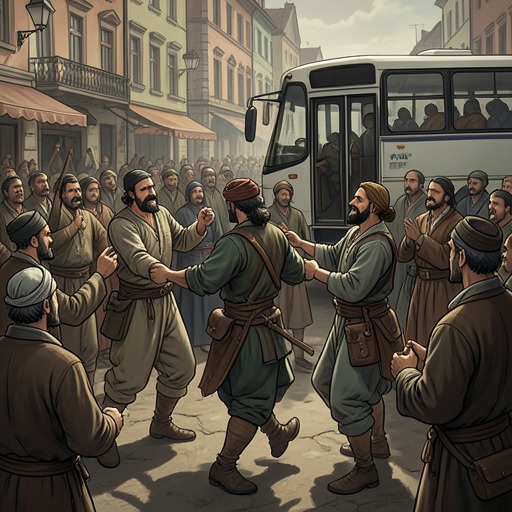
Kathakali Men
The God of Small ThingsKathakali Men are performers whose bodies serve as their sole instruments and whose inherited stories shape how they understand the world. The novel presents them both as devoted custodians of narrative and as working artists compelled to sell their performances to tourists, making their lives a measure of the distance between cultural practice and its commercial display.
Identity and Storytelling
For a Kathakali Man, the stories are not merely repertoire: they are bound to childhood, upbringing, and perception. The narrative compares them to a home, a childhood landscape, and windows through which the world becomes visible. Telling a story is therefore an intimate act of handling something cherished, not simply reciting a fixed sequence of events.
Their storytelling moves freely across scale and tone. A performer can traverse whole worlds in minutes, yet pause over a small detail; shift from the violence of war to a woman washing her hair, from a demon’s inventive energy to everyday gossip, or from maternal tenderness to Krishna’s smile. These transitions reveal a form whose range depends on bodily presence and the capacity to make contrasting moods inhabit a single performance.
The Body as Instrument
The performer’s body is described as both instrument and soul: the means through which the stories become visible and the central possession he can offer to an audience. This makes artistic skill inseparable from physical performance. His work does not stand apart from him as an object; it is made through him, in the moment of telling and dancing.
That dependence also sharpens the vulnerability of the profession. When circumstances leave the performers with tourism as an outlet, they enter the market with their stories as the one thing they own and can sell. The body that carries a tradition becomes, at the same time, the means by which that tradition earns a fee.
Tourism and the Market
The performers turn to tourism in despair, hawking the stories their bodies can tell. At the History House, they perform for visitors whose conduct and attention are presented as alienating to the artists. The account emphasizes the strain between the performers’ deep relation to their stories and an audience that receives the performance as a tourist attraction.
They nevertheless complete the work, collect their fee, and leave. Some drink or smoke afterward; then the performers go to the Ayemenem Temple and dance to ask pardon of the gods. The sequence sets payment beside ritual: the same art that has been offered to visitors returns to a religious setting, where dancing takes on a different purpose. Their passage between market and temple registers neither a simple rejection of tourism nor an uncomplicated acceptance of it, but the pressure of earning a living while remaining answerable to a cultural and sacred inheritance.
Performance and Private Life
The novel also refuses to let artistic beauty stand as a complete account of the performers. After taking off their makeup, the Kathakali Men go home and beat their wives. The contrast between expressive mastery onstage and violence in domestic life complicates any idealization of the artist: a body capable of giving stories emotional and imaginative range does not, by that fact, ensure humane conduct beyond performance.
This juxtaposition matters to the novel’s interest in the difference between representation and lived behavior. The performers can embody tenderness, conflict, and transformation in stories, yet their private actions expose a sharp failure to carry those possibilities into their relationships. Their theatrical skill is real, but it does not absolve or explain away the harm they cause.
Narrative Significance
The Kathakali Men’s story brings together inheritance, labor, and contradiction. Their stories form a childhood home and a way of seeing; tourism turns that inheritance into work for visitors; and the return to the temple places commercial performance beside an appeal to the sacred. At the same time, the revelation of violence at home prevents the art from functioning as a moral certificate for its practitioners.
Through this group, the novel distinguishes the richness of a cultural form from the conditions under which its bearers live and work. The performers’ stories can contain worlds, but their own circumstances are shaped by the market and by behavior that contradicts the humane possibilities of art. Their significance lies in this unresolved tension, not in a claim that artistic tradition automatically transforms the people who sustain it.